Pinui-binui, Israel's evacuate-and-rebuild track, is a deal in which the owners of an old building hand it over to a developer, the developer demolishes it and builds a new, larger building in its place, and every owner receives a new apartment in the new building. The developer pays for everything and makes its money on the additional apartments it sells. For example: a building of 16 units becomes a building of 64 units, an apartment ratio of 1 to 4: 16 go back to the owners, 48 are sold. The square meters you are asking about are the difference between the old apartment and the new one: how much extra floor area, a balcony, a storage room, parking.
So is there a number? No. No section of any statute says how many square meters you are owed. There is city policy, there is an appraisal standard, and there is the project's economics. But the number that binds anyone is born in one place: the agreement you sign with the developer. And an agreement already signed? It binds the developer too. The developer cannot take square meters off it on its own: that takes a new document with your signature on it, and you are not obligated to sign that document. Unless the agreement itself already ties the square meters to the plan that gets approved. More on that below.
If not by statute, how are the square meters in your new apartment set?
In three layers, and none of them is a section of a statute. The first layer is the city's policy on owner terms, where one exists: a document from the municipality or the local planning committee stating what addition is customary in its complexes. Not every city has one, and no two look alike. The second layer is the appraisal standard. The third, and the only one that binds the developer to you, is the agreement.
What is the appraisal standard? Standard 21.1 is a guideline of Israel's Council of Real Estate Appraisers, in force since June 2022, that tells an appraiser how to test whether a pinui-binui plan is economically viable. The appraiser assumes that every owner receives a new apartment with a balcony, a storage room and parking, at the permitted floor area of the existing apartment plus an addition: per the city policy where there is one, and where there is none, in tiers of 0, 12 and 25 square meters. And this is where most guides get it wrong. Those tiers are working assumptions for a calculation. The standard says so itself:
"Nothing in this statement sets a minimum or a maximum of what owners actually receive." — Real Estate Appraisal Standard 21.1, Council of Real Estate Appraisers, 2022 (unofficial translation)
What does that mean in plain English? That 12 square meters is not "what you are owed" and 25 square meters is not a cap. A building in a strong location, with a generous plan and a developer that wants the complex, can close higher. A building in a weak location can close lower. The number is the outcome of a negotiation with the developer, and it rests on the economics of the project.
Bottom line: your square meters are set in the agreement. The policy and the standard are the opening position for a negotiation, not its result.
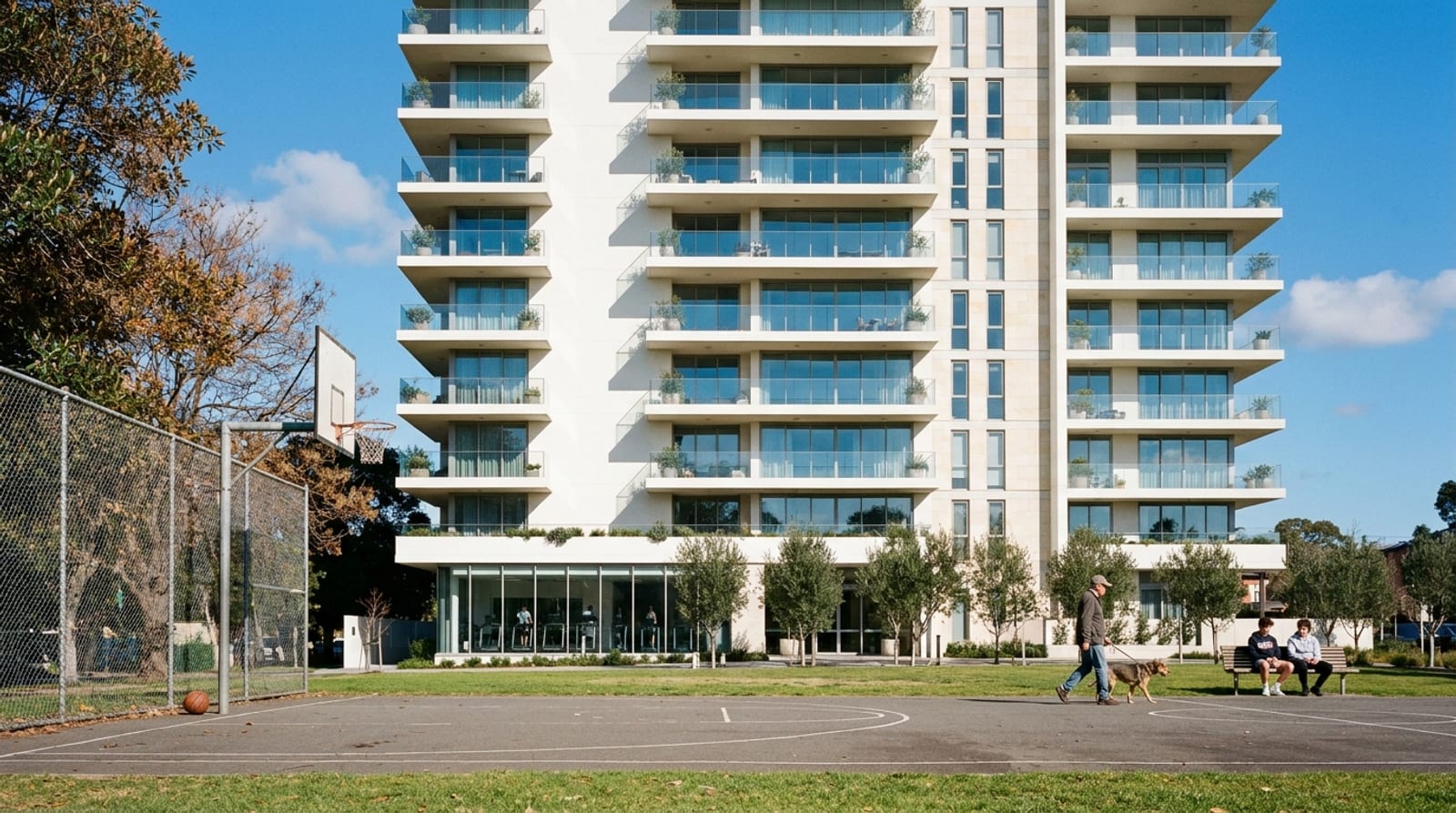
Big apartment, small apartment: does everyone get the same?
The statute does not answer that. Nothing in the Pinui-Binui Law requires identical terms for every apartment, and nothing in it requires terms proportional to size. You see both models in the market: "everyone gets 12 square meters" alongside "everyone gets 25% on top of their own area," and there are hybrids. The appraisal standard, for its part, applies one uniform key to the building's typical apartments that accounts for the differences in area between them, and for the atypical ones, with a roof, a garden or an appurtenance, a key based on their value relative to the typical ones. But that is a calculation method for the appraiser, not a rule that binds your agreement.
What does the statute require? Disclosure. Anyone who approaches you on the developer's behalf, or who is paid by the developer, or whose fee depends on the deal going through, must tell you, on their own initiative, about any difference that is not trivial between what you receive and what another owner in the building receives. The statute does not say what "trivial" means, so there is no numeric threshold here. What there is, is a duty:
"…shall report, on their own initiative, to the apartment owners in the cluster any difference in the terms, other than a trivial one, that an apartment owner in the cluster will receive compared with other apartment owners in the same cluster." — Pinui-Binui Law (Encouragement of Evacuation-Reconstruction Projects), 5766-2006 (unofficial translation)
And that duty has teeth. A breach of the duty of disclosure gives the owner grounds to withdraw their consent to the deal, even after signing a binding agreement. That does not mean the agreement is void on its own. It is a cause of action: whoever holds it can use it, and in a dispute the court decides. And in the more extreme case, where the developer or someone acting for it gave you misleading information, say about how many neighbors have already signed or the terms agreed with them, the Commissioner for residents' complaints at the Government Authority for Urban Renewal may declare the deal void.
Bottom line: equal or proportional is the building's decision. What is not allowed is hiding from you that the neighbor got more.

The developer wants to reopen the agreement and cut square meters. Can it?
Not on its own. An agreement you signed binds the developer too. It cannot take square meters off your deal or change your terms by notice: a change like that needs your consent and your signature on a new document. If the developer simply does not deliver what it committed to, that is a breach of contract, and you can ask a court to order specific performance. That is ordinary contract law, not a special renewal statute: a contract is formed by agreement and changed by agreement. And nothing in the renewal statutes themselves lets the developer, or a majority of the neighbors, change the terms of a signed agreement without the owner.
Still, before you say "no," read the agreement. Because four things can change the picture, and all of them are written either in the agreement or in the plan:
Bottom line: square meters do not come off a signed agreement without your signature. The question is what you already signed, and you read that before you answer.

And what if the cut comes from the city, not the developer?
It happens. A scenario from the field, no names: the buildings in a complex signed with a developer for a substantial addition of square meters per apartment. The plan reached the local planning committee, and the committee recommended depositing it with a far smaller addition, because it wanted more public space in the complex. The developer did not change a word of the agreement. The numbers changed in the plan. And then it shows up at the owners' door with an addendum.
Here you have two tools. The first is the agreement: if it has no adjustment clause, the cut in the plan does not change what the developer committed to, and whether it can deliver becomes the developer's problem. The second is planning law: an owner in the complex is "anyone with an interest in the land" under the Planning and Building Law and may object to a plan on deposit, the public-objection stage. The objection is filed within 2 months of the notice of deposit: written, reasoned, with an affidavit attached. Whoever misses the 2 months misses the arena where the square meters are actually decided.
And there is a third tool, which few people know to ask for. The appraisal prepared under the standard is published, per a Ministry of Justice directive, when the plan is deposited, so that owners can see the calculation and the developer's expected profit. When the developer says "at this addition the project doesn't pencil out," that document is the answer: it states the terms and the profit at which the plan was tested. And if there is a genuine dispute over viability, you can ask the Government Authority for Urban Renewal for a pinui-binui appraiser, who determines whether the deal is viable, and if not, on what terms it would be.
Bottom line: when the cut is in the plan, you answer in two places: in the agreement, and in an objection within 2 months.

You signed, and now it turns out the neighbor got more. Is there anything to do?
Yes, and from the very first moment. The statute requires that whoever approaches you on the developer's behalf say so clearly in the first approach, before signing, and in the text of the agreement itself. And that the same party report to you, on their own initiative, any non-trivial gap in terms between you and a neighbor. If that did not happen, you have grounds to withdraw your consent, even after signing. And if the agreement contains a clause in which you "waive" the provisions of the Pinui-Binui Law, that clause is void: the statute provides that a term waiving its provisions to an owner's detriment does not hold.
What else are you owed before the first signature? A meeting of the apartment owners, and after it, at least 14 days before the first deal in the building, a principal-terms document: the principles by which the developer sets the terms, the guarantees it offers, and its track record. That document is the baseline. When an addendum arrives, lay it beside the principal-terms document and look at what moved.
Bottom line: disclosure is the developer's duty, not a favor. A breach opens a door out for you, even after you signed.

Who cuts, and what holds: the situations side by side
| Situation | What governs | Your move |
|---|---|---|
| The developer asks you to sign an addendum that cuts | Contract law: changing an agreement takes both sides' consent | Do not sign before reading. The addendum is reviewed as a new agreement |
| The agreement has a plan-adjustment clause | The wording of the clause: formula, floor, who decides | Confirm the adjustment is uniform for everyone and applied as written |
| The committee reduced the rights in the plan | Planning and Building Law: objection within 2 months | Objection in writing, reasoned, with an affidavit; request the appraisal published at deposit |
| A gap in terms versus the neighbors comes to light | Pinui-Binui Law: duty to disclose any non-trivial gap | Grounds to withdraw consent; for misleading information, a complaint to the Commissioner for residents' complaints |
| The developer says "it doesn't pencil out" | The appraisal under Standard 21.1; a pinui-binui appraiser from the Authority | Demand the calculation; request a pinui-binui appraiser |
You received an addendum from the developer: 6 steps before you sign
- 1Pull out the signed agreement and the principal-terms document. What exactly was promised: fixed square meters, a formula, or "subject to the plan"?
- 2Locate where the cut comes from. The developer, or the plan? If the plan, when was the deposit published and when do the 2 months run out?
- 3Ask for the calculation. The appraisal published with the deposit, and the developer's explanation of why the numbers no longer work.
- 4Compare with the neighbors. Did everyone get the same addendum? A non-trivial gap must be disclosed.
- 5Handle it together, as one building, through the owners' committee and the owners' attorney. An addendum is a renegotiation with the developer, not a form.
- 6Sign, if at all, an addendum you reviewed as a new agreement. Terms, timelines, guarantees, and what happens if the plan changes this time too.
What to verify before you decide

Your questions, answered
Our city has no policy on owner terms. So what is the negotiation based on?
On the economics of the project, and on what the market closes at in comparable complexes. Without a city policy, the appraiser who tests the plan calculates by the tiers in the standard, and by the agreement between you and the developer if one already exists. But the standard sets no minimum and no maximum. A developer offering "12 square meters because that is what the standard says" is quoting an appraiser's working assumption as if it were law.
What works in a negotiation is a calculation: how many apartments are sold, at what price, and what is left after construction and financing. You ask for that calculation; you do not guess it.
The developer says the project doesn't pencil out at the addition that was promised. How do you check whether that's true?
In a document the developer is not always happy to show: the appraisal prepared under Standard 21.1 and published when the plan was deposited. It was written precisely so that owners can see the calculation and the developer's profit the plan was tested against. If the plan was tested and found viable at the addition in the agreement, "it doesn't pencil out" needs an explanation.
And if the dispute is genuine, you can ask the Government Authority for Urban Renewal for a pinui-binui appraiser. The appraiser determines whether the deal is economically viable, and if not, on what terms it would be. That determination is a reference point that is hard to argue with.
Most of the neighbors have already signed the addendum that cuts. If I refuse, am I a holdout?
The holdout mechanism in the Pinui-Binui Law deals with refusing to sign a deal: when a special majority has agreed to enter into a deal and an owner refuses unreasonably, the court may hold that owner liable in damages to the neighbors, or approve the deal and appoint someone to sign in their name. Refusing to give up terms in an agreement already signed is a different question, and the statute does not address it expressly. So no one can promise you a clear-cut answer, in either direction.
What is written: a refusal is not unreasonable, among other cases, when the deal is not economically viable for the owner, when no alternative housing was offered for the construction period, when no adequate guarantees were offered, or when there are special personal circumstances. A reasonable refusal, reasoned and documented, is a position. A silent refusal is a risk.
Everyone talks about 12 square meters and a balcony. Is that what we're owed?
It is a number that appears in the appraisal standard as one of three calculation tiers (0, 12 and 25 square meters), used where there is no city policy, alongside an assumption of a 12-square-meter balcony and a 7-square-meter storage room where the project allows. The standard adds expressly that this sets no minimum or maximum of what owners actually receive. In other words: it is a working assumption for an appraiser testing a plan. It promises you nothing, and it does not cap you either.
What you are "owed": what the agreement says, after a negotiation built on the project's calculation. Some complexes close lower, and some close far higher.
If the new apartment is much bigger than the old one, is there tax on that?
The sale of the old apartment to the developer in exchange for a new one is exempt from appreciation tax up to a "value ceiling" set by the Real Estate Taxation Law: the highest of three alternatives, among them 150% of the value of the apartment sold, the value of an apartment in the same complex with a floor area of 120 square meters, and the value of an apartment in the same complex with a floor area of 150% of the apartment sold, up to 200 square meters. Anything above the ceiling is taxable. Note: it is a value ceiling, not an area ceiling, and it is "the highest of," not the lowest.
You compare your terms with the ceiling before signing. An apartment that was declared an investment at the time, or questions about an exemption used in the past, are checked against the facts of the case, before signing.
Before you sign, or after an addendum arrives: send us the terms clause from your agreement on WhatsApp, and we will tell you what it holds and what the developer can change in it.
Square meters don't come off on their own
How many square meters you get is set once, in the agreement, after a negotiation built on a calculation and not on "that's how it's done." And when someone asks to reopen the agreement, the answer lies in three documents: the agreement itself, the deposited plan, and the appraisal published with it. At the Law Office of Noam Gottlib, urban renewal attorneys, we represent apartment owners across from the developer: we negotiate the terms clause, answer the addendum when it arrives, and file the objection when the cut comes from the committee. The stage before all of this, the majority required from the apartment owners, and what comes after, the types of guarantees for apartment owners and who pays the rent during construction, and what happens when you want to sell midway, selling an apartment in a building entering pinui-binui, are covered in our guides.
Before signing, or after an addendum? Send us the terms clause. We will tell you what it holds.
Your square meters are not a favor from the developer and not a number from a standard. They are an agreement. Read it before you answer, keep your apartment, and close with confidence.
Sources: the Pinui-Binui Law (Encouragement of Evacuation-Reconstruction Projects), 5766-2006 · the Contracts (General Part) Law, 5733-1973 · the Contracts (Remedies for Breach of Contract) Law, 5731-1970 · the Planning and Building Law, 5725-1965 · the Real Estate Taxation (Appreciation and Purchase) Law, 5723-1963 · Real Estate Appraisal Standard 21.1, Council of Real Estate Appraisers, 2022, and the Ministry of Justice (Counseling and Legislation) letter of June 22, 2022. This article is general information, not legal advice; every agreement is read on its own wording and circumstances.
A preferred source just means you'll see our new articles more often in Top Stories next time you search a topic like this. It's also a nice way to say thanks.
Add as a preferred source on Google (opens in a new tab)
General information — not legal advice.